I read an interesting article by Reuters on Friday.
The story dissected the battle over the next generation of DVDs and suggested that "Porn could be the key" to success in the war.
The combatants are HD-DVD and Blu-ray. For those not familiar with the formats, both are high density optical discs that store data and video. Wikipedia says: "HD DVD has a lower disc capacity per layer (15 GB vs 25 GB)" than Blu-ray, which can hold more data. Sony backs Blu-ray while Toshiba backs HD-DVD.
Blu-ray is also supported by Hewlett-Packard, Apple, Dell and Panasonic. "[F]ive Hollywood studios exclusively support Blu-ray Disc: Columbia Pictures, MGM, Disney, Lionsgate and 20th Century Fox (Columbia Pictures and MGM are owned by Sony Pictures)." [Wikipedia]
HD-DVD is also supported by NEC Corporation, Microsoft, and Intel. "Two Hollywood studios exclusively support HD DVD: Universal Studios and the Weinstein Company." [Wikipedia]
Four studios support both formats: Paramount Pictures, DreamWorks, Warner Bros. and New Line Cinema. [Wikipedia]
The Reuters article says: "HD-DVD machines are cheaper but Blu-ray has backing of a majority of the mainstream studios and an advantage in that the format is compatible with the PlayStation 3, the latest version of Sony's popular series of video game consoles."
However, thus far, Blu-ray has blocked the porn industry from manufacturing discs in that format. If the porn industry chooses to throw its weight behind HD-DVD, it may change the balance of power in the battle for hegemony.
The article claims that, thirty years ago, VHS won out over Betamax "in part because of the adult film industry, and now some see blue movies playing a key role again as backers of HD-DVD and Blu-ray maneuver to make their formats the standard."
Stay tuned . . .
Sunday, April 08, 2007


Saturday, April 07, 2007
Birthday Surprise
My car is in the shop today. Something to do with the oxygen exchange (???)
We'd dropped it off and had breakfast out (I just love eating breakfast out). Upon our return home, I found a package from Penguin sitting on the front step.
It was the proofs for my book!
Talk about timing. It couldn't have come on a better day for me. Doing the happy dance!
We'd dropped it off and had breakfast out (I just love eating breakfast out). Upon our return home, I found a package from Penguin sitting on the front step.
It was the proofs for my book!
Talk about timing. It couldn't have come on a better day for me. Doing the happy dance!
Coming Soon
Almost exactly three years ago, feeling frustrated and confused, I made the decision to join Romance Writers of America. I was conflicted about the decision. I wanted to write suspense, not romance.
I made the decision to join RWA out of a recognition that I needed to learn more about the publishing industry. Although I'd attended meetings of half a dozen writers' groups, I hadn't yet found an organization that offered the kind of education I wanted. This was about a year before agent and editors' blogs started popping up on the Internet.
I've never regretted my decision. Although the membership is more expensive than most ($100 to join, $75 each year thereafter), it's given me my money's worth. RWA is ALL about getting published, and believe me, they're dead serious about it.
There are three RWA chapters within thirty miles of my home. I visited all three while trying to decide which one to join. Like Goldilocks, I decided one was too large for me, one was too small and one was just right.
My chapter has a fair number of published writers, and I've beem overwhelmed by their generosity to their unpublished counterparts. They provide monthly presentations, free critiques, advice and encouragement. Among the kindest is Karen Kelley.
Since 2004, Karen has published eight romances. All of them are sexy, fun romps. She's made me laugh out loud in public more than once. The latest--Close Encounters of the Sexy Kind--came out earlier this week. I've asked Karen to visit us on this blog later this month to talk about her new book, writing and her path to becoming published.
You'll like Karen as much as I do; I promise. You can visit her blog here and buy CEOTSK here.
In the meantime, today is my birthday, and I'm off to celebrate. Catch you later.
I made the decision to join RWA out of a recognition that I needed to learn more about the publishing industry. Although I'd attended meetings of half a dozen writers' groups, I hadn't yet found an organization that offered the kind of education I wanted. This was about a year before agent and editors' blogs started popping up on the Internet.
I've never regretted my decision. Although the membership is more expensive than most ($100 to join, $75 each year thereafter), it's given me my money's worth. RWA is ALL about getting published, and believe me, they're dead serious about it.
There are three RWA chapters within thirty miles of my home. I visited all three while trying to decide which one to join. Like Goldilocks, I decided one was too large for me, one was too small and one was just right.
My chapter has a fair number of published writers, and I've beem overwhelmed by their generosity to their unpublished counterparts. They provide monthly presentations, free critiques, advice and encouragement. Among the kindest is Karen Kelley.
Since 2004, Karen has published eight romances. All of them are sexy, fun romps. She's made me laugh out loud in public more than once. The latest--Close Encounters of the Sexy Kind--came out earlier this week. I've asked Karen to visit us on this blog later this month to talk about her new book, writing and her path to becoming published.
You'll like Karen as much as I do; I promise. You can visit her blog here and buy CEOTSK here.
In the meantime, today is my birthday, and I'm off to celebrate. Catch you later.
Friday, April 06, 2007
So, Who is Clifford Irving?
There's a new film opening next Friday that I'm looking forward to seeing. The Hoax is a fictionalized re-telling of a real event, an event I know about because I once met the man who pulled the actual hoax off.
In 1970, Clifford Irving was an accomplished forty-year-old writer who'd published three novels and a biography about an art forger. While his books had garnered some critical acclaim, he was dead broke. The fact that he was on his fourth marriage (and seeing a mistress, too) might have had something to do with the state of his finances.
Perhaps inspired by Elmyr de Hory, the art forger whose story he'd told, Irving hit upon an audacious scheme: he decided to write the story of Howard Hughes, the wealthy and by-that-time legendary recluse. However, instead of simply writing an unauthorized biography, Irving decided to write Hughes' autobiography--by forging letters and faking interview transcripts in which Hughes told his own life story.
There was only one small catch: Hughes was still alive at the time.
I know. It sounds crazy. But Irving reasoned that Hughes, who was by then considered a total nut job and who had not been seen in public for over a decade, would never come out of hiding to denounce the book. And, even if he did, who would believe him?
Irving approached his publisher, McGraw-Hill (M-H), and told them that Hughes had liked his earlier biography of the forger and wanted Irving's assistance in writing an autobiography. The writer showed the M-H editors three letters he had forged in which Hughes proposed the project. Hughes supposedly agreed to multiple interviews with Irving.
McGraw-Hill eventually paid a $765,000 advance, giving $100,000 to Irving and the rest in a check payable to Howard Hughes. Irving's wife Edith deposited the Hughes' check into a Swiss bank using the name H.R. Hughes for Helga R. Hughes.
Irving stressed to his publishers that Hughes wanted the project to remain top secret. [grin]
Irving had enlisted the help of an author friend, Richard Suskind, in his planned hoax. Their research was meticulous. They actually got hold of the unpublished memoirs of Hughes' ex-business manager, which they used to add verisimilitude to their book.
Meanwhile, M-H was doing its due diligence on the "autobiography." They had a handwriting analyst confirm the authenticity of the letters Irving had forged (he must have learned a thing or two doing that earlier biography on the art forger). They announced the release of the book for March, 1972.
By now, people who knew Hughes were beginning to question the autobiography. Irving used Hughes' well-known penchant for secrecy to his advantage, claiming that the recluse hadn't told anyone about the project. Mike Wallace interviewed Irving. Later, according to Wikipedia, Wallace said his camera crew pegged Irving as a total phony, but he, Wallace, was taken in.
On 1/7/72, Hughes held a telephone conference in which he publicly denounced the forthcoming book. Amazingly, Irving held his ground, claiming the voice on the phone wasn't Hughes. But things were beginning to unravel.
Hughes filed suit against McGraw-Hill and Irving. The authorities followed up on the advance deposited in that Swiss account. Finally, on 1/28/72, Edith and Clifford Irving confessed their fraud. Irving and Suskind were sentenced to prison. Irving served seventeen months while Suskind served six and Irving's wife spent a year in a Swiss jail for fraud.
The story doesn't stop there. After his release from prison, Irving got divorced again, but continued to write. He penned several best sellers, including a 1988 book called Daddy's Girl, a true crime about a wealthy Houston couple murdered in their bed. Their daughter and her boyfriend were convicted for the crime.
In the mid-eighties, I had my first brush with someone I recognized as a true sociopath--an amoral person without any sense of conscience at all. The experience made an enormous impression on me; I felt I had stumbled upon evil, and it frightened me deeply. For a number of years, I read everything I could find on psychopathology, including true crime books. Eventually that interest led to my becoming a psychiatric social worker. In the short term, however, I came across Irving's Daddy's Girl, which I found to be very well written.
On April 26, 1988, I attended a luncheon offered by the Friends of the Dallas Public Library, at which Clifford Irving--flacking the newly released Daddy's Girl--spoke. His subject was "Today's Journalism--Tomorrow's History: Fact or Fiction."
Not surprisingly, Irving was glib and charming and spoke openly of the Hughes hoax. He had, by that time, written his own story, aptly titled The Hoax. IMDB lists it as the source material for the current film. I was amused to see that they listed it as a "novel" as opposed to "memoir." That's probably a fitting epitaph for Irving who is today seventy-seven and living in Aspen.
I checked my bookshelves tonight. I still have my autographed copy of Daddy's Girl. And I'm looking forward to The Hoax's opening next Friday.
Postscript: Turns out the film is opening today. Since my birthday is tomorrow, we're starting the celebration early by going to see the film this afternoon at 2:45.
In 1970, Clifford Irving was an accomplished forty-year-old writer who'd published three novels and a biography about an art forger. While his books had garnered some critical acclaim, he was dead broke. The fact that he was on his fourth marriage (and seeing a mistress, too) might have had something to do with the state of his finances.
Perhaps inspired by Elmyr de Hory, the art forger whose story he'd told, Irving hit upon an audacious scheme: he decided to write the story of Howard Hughes, the wealthy and by-that-time legendary recluse. However, instead of simply writing an unauthorized biography, Irving decided to write Hughes' autobiography--by forging letters and faking interview transcripts in which Hughes told his own life story.
There was only one small catch: Hughes was still alive at the time.
I know. It sounds crazy. But Irving reasoned that Hughes, who was by then considered a total nut job and who had not been seen in public for over a decade, would never come out of hiding to denounce the book. And, even if he did, who would believe him?
Irving approached his publisher, McGraw-Hill (M-H), and told them that Hughes had liked his earlier biography of the forger and wanted Irving's assistance in writing an autobiography. The writer showed the M-H editors three letters he had forged in which Hughes proposed the project. Hughes supposedly agreed to multiple interviews with Irving.
McGraw-Hill eventually paid a $765,000 advance, giving $100,000 to Irving and the rest in a check payable to Howard Hughes. Irving's wife Edith deposited the Hughes' check into a Swiss bank using the name H.R. Hughes for Helga R. Hughes.
Irving stressed to his publishers that Hughes wanted the project to remain top secret. [grin]
Irving had enlisted the help of an author friend, Richard Suskind, in his planned hoax. Their research was meticulous. They actually got hold of the unpublished memoirs of Hughes' ex-business manager, which they used to add verisimilitude to their book.
Meanwhile, M-H was doing its due diligence on the "autobiography." They had a handwriting analyst confirm the authenticity of the letters Irving had forged (he must have learned a thing or two doing that earlier biography on the art forger). They announced the release of the book for March, 1972.
By now, people who knew Hughes were beginning to question the autobiography. Irving used Hughes' well-known penchant for secrecy to his advantage, claiming that the recluse hadn't told anyone about the project. Mike Wallace interviewed Irving. Later, according to Wikipedia, Wallace said his camera crew pegged Irving as a total phony, but he, Wallace, was taken in.
On 1/7/72, Hughes held a telephone conference in which he publicly denounced the forthcoming book. Amazingly, Irving held his ground, claiming the voice on the phone wasn't Hughes. But things were beginning to unravel.
Hughes filed suit against McGraw-Hill and Irving. The authorities followed up on the advance deposited in that Swiss account. Finally, on 1/28/72, Edith and Clifford Irving confessed their fraud. Irving and Suskind were sentenced to prison. Irving served seventeen months while Suskind served six and Irving's wife spent a year in a Swiss jail for fraud.
The story doesn't stop there. After his release from prison, Irving got divorced again, but continued to write. He penned several best sellers, including a 1988 book called Daddy's Girl, a true crime about a wealthy Houston couple murdered in their bed. Their daughter and her boyfriend were convicted for the crime.
In the mid-eighties, I had my first brush with someone I recognized as a true sociopath--an amoral person without any sense of conscience at all. The experience made an enormous impression on me; I felt I had stumbled upon evil, and it frightened me deeply. For a number of years, I read everything I could find on psychopathology, including true crime books. Eventually that interest led to my becoming a psychiatric social worker. In the short term, however, I came across Irving's Daddy's Girl, which I found to be very well written.
On April 26, 1988, I attended a luncheon offered by the Friends of the Dallas Public Library, at which Clifford Irving--flacking the newly released Daddy's Girl--spoke. His subject was "Today's Journalism--Tomorrow's History: Fact or Fiction."
Not surprisingly, Irving was glib and charming and spoke openly of the Hughes hoax. He had, by that time, written his own story, aptly titled The Hoax. IMDB lists it as the source material for the current film. I was amused to see that they listed it as a "novel" as opposed to "memoir." That's probably a fitting epitaph for Irving who is today seventy-seven and living in Aspen.
I checked my bookshelves tonight. I still have my autographed copy of Daddy's Girl. And I'm looking forward to The Hoax's opening next Friday.
Postscript: Turns out the film is opening today. Since my birthday is tomorrow, we're starting the celebration early by going to see the film this afternoon at 2:45.
Thursday, April 05, 2007
How To Bury A Book & the Ten Greatest Books
Jeanne Laws brought an interesting article by Stephen King to my attention today. It's in the April 6th issue of Entertainment Weekly.
The article was a combination book review, commentary and rant. I'm going to summarize all three for you here:
BOOK REVIEW: King describes a new novel titled Fieldwork by Mischa Berlinski and published by Farrar, Straus and Giroux. In his own words, "Under the drab title and the drab cover, there's a story that cooks like a mother." He also says: "It has an exotic locale, mystery, and a narrative voice full of humor and sadness . . . It's a Russian doll of a read, filled with stories within stories."
COMMENTARY: King's chief problem is the current "elitist twaddle" that insists "there's a difference between 'literature' and 'popular fiction'." He believes that publishing houses are shooting themselves in the foot by giving great books lousy titles and even lousier covers. "Fieldwork's cover is a green smear (probably jungle) and a gray smear (probably sky). It communicates nothing."
RANT: King asks why publishing houses don't SELL their books. He suspects it may be because the publishers believe readers "are too dumb to enjoy a killer novel like Fieldwork. If so, shame on them for their elitism." He suggests that Fieldwork should have been given a cover that showed the heroine "embracing her lover or dancing" with a native tribe.
I grinned as I read King's article. One of my pet peeves are people with a superior attitude who say, "I never read genre fiction." These are usually the same folk who say, "I never watch television." Oh, give me a break.
I read the way I approach life: I like lots of variety in both. I read for information, for entertainment, for inspiration, for education, and for the sheer love of it. I read horror, sci-fi, paranormal, romance, mystery, the classics and the newer literary fiction with equal gusto.
Why do we have to be intellectual snobs? I was amused early last month when The Guardian Unlimited printed a book review on a new paperback titled The Top Ten. The book lists the top ten greatest works of fiction as compiled by J. Peder Zane, the book review editor of the Raleigh News and Observer. Zane contacted "125 leading writers" to ask what they thought were the ten greatest works of literature of all time.
You can almost hear the writer of The Guardian sniff as he says: "This is an American paperback with (mainly) American correspondents whose personal libraries have a natural North American bias, plus a distinct affection for the novels of Kazuo Ishiguro."
Here's the list, obviously top-heavy with North American writers:
Top 10 of all time according to Zane
1. Anna Karenina by Leo Tolstoy
2. Madame Bovary by Gustave Flaubert
3. War and Peace by Leo Tolstoy
4. Lolita by Vladimir Nabokov
5. The Adventures of Huckleberry Finn by Mark Twain
6. Hamlet by William Shakespeare
7. The Great Gatsby by F. Scott Fitzgerald
8. In Search of Lost Time by Marcel Proust
9. The Stories of Anton Chekhov
10. Middlemarch by George Eliot
To be fair, I'm sure the Zane's book includes all the choices of the 125 writers so the penchant for "North American" novels is probably more pronounced in their other picks.
All the same, I think King is right. A good story is a good story, no matter the genre (or even the nationality of the writer). Readers who love romance will like Gatsby. Readers who love adventures can appreciate Huck Finn. If publishers sell readers short, they're hurting themselves (and their authors).
The article was a combination book review, commentary and rant. I'm going to summarize all three for you here:
BOOK REVIEW: King describes a new novel titled Fieldwork by Mischa Berlinski and published by Farrar, Straus and Giroux. In his own words, "Under the drab title and the drab cover, there's a story that cooks like a mother." He also says: "It has an exotic locale, mystery, and a narrative voice full of humor and sadness . . . It's a Russian doll of a read, filled with stories within stories."
COMMENTARY: King's chief problem is the current "elitist twaddle" that insists "there's a difference between 'literature' and 'popular fiction'." He believes that publishing houses are shooting themselves in the foot by giving great books lousy titles and even lousier covers. "Fieldwork's cover is a green smear (probably jungle) and a gray smear (probably sky). It communicates nothing."
RANT: King asks why publishing houses don't SELL their books. He suspects it may be because the publishers believe readers "are too dumb to enjoy a killer novel like Fieldwork. If so, shame on them for their elitism." He suggests that Fieldwork should have been given a cover that showed the heroine "embracing her lover or dancing" with a native tribe.
I grinned as I read King's article. One of my pet peeves are people with a superior attitude who say, "I never read genre fiction." These are usually the same folk who say, "I never watch television." Oh, give me a break.
I read the way I approach life: I like lots of variety in both. I read for information, for entertainment, for inspiration, for education, and for the sheer love of it. I read horror, sci-fi, paranormal, romance, mystery, the classics and the newer literary fiction with equal gusto.
Why do we have to be intellectual snobs? I was amused early last month when The Guardian Unlimited printed a book review on a new paperback titled The Top Ten. The book lists the top ten greatest works of fiction as compiled by J. Peder Zane, the book review editor of the Raleigh News and Observer. Zane contacted "125 leading writers" to ask what they thought were the ten greatest works of literature of all time.
You can almost hear the writer of The Guardian sniff as he says: "This is an American paperback with (mainly) American correspondents whose personal libraries have a natural North American bias, plus a distinct affection for the novels of Kazuo Ishiguro."
Here's the list, obviously top-heavy with North American writers:
Top 10 of all time according to Zane
1. Anna Karenina by Leo Tolstoy
2. Madame Bovary by Gustave Flaubert
3. War and Peace by Leo Tolstoy
4. Lolita by Vladimir Nabokov
5. The Adventures of Huckleberry Finn by Mark Twain
6. Hamlet by William Shakespeare
7. The Great Gatsby by F. Scott Fitzgerald
8. In Search of Lost Time by Marcel Proust
9. The Stories of Anton Chekhov
10. Middlemarch by George Eliot
To be fair, I'm sure the Zane's book includes all the choices of the 125 writers so the penchant for "North American" novels is probably more pronounced in their other picks.
All the same, I think King is right. A good story is a good story, no matter the genre (or even the nationality of the writer). Readers who love romance will like Gatsby. Readers who love adventures can appreciate Huck Finn. If publishers sell readers short, they're hurting themselves (and their authors).
Wednesday, April 04, 2007
Another Publishing Scam
Publishers Weekly (PW) had two articles in the last week about a scam directed toward booksellers.
Last Thursday, PW reported on a Seattle bookstore owner who recently took an order over the phone for two copies of a book titled The Shortcut: 20 Stories to Get You from Here to There. The customer, who identified himself as Michael Evers, provided a credit card number.
The Shortcut's publisher is Author Identity Press, a vanity press.
The bookseller placed the order through Ingram, the wholesale distributor. The two non-returnable books arrived, followed by the news that the credit card wasn't real.
The bookstore owner was so annoyed by the scam that he posted the story on the Independent Mystery Booksellers Association listserv to warn his peers. One after another, booksellers in different states came forward to admit being ripped off by a man giving the same name and ordering the same book.
This is where it gets interesting. The twenty short stories in the book are a mix of public domain works by well-known authors such as Edgar Allan Poe, Mark Twain and Charles Dickens along with stories by novice writers.
PW reports that the name the phony customer gave, Michael Evers, "is the name of the main character in a suspense novel called The Palace of Wisdom: A Rock and Roll Fable by Kevin A. Fabiano, printed by another in-demand publisher, Publish-America. Fabiano, whose Web site http://kevinfabiano.com says he's a New York lawyer, is also one of the contributing authors to The Shortcut."
I guess that's one way to sell your self-pubbed book.
Last Thursday, PW reported on a Seattle bookstore owner who recently took an order over the phone for two copies of a book titled The Shortcut: 20 Stories to Get You from Here to There. The customer, who identified himself as Michael Evers, provided a credit card number.
The Shortcut's publisher is Author Identity Press, a vanity press.
The bookseller placed the order through Ingram, the wholesale distributor. The two non-returnable books arrived, followed by the news that the credit card wasn't real.
The bookstore owner was so annoyed by the scam that he posted the story on the Independent Mystery Booksellers Association listserv to warn his peers. One after another, booksellers in different states came forward to admit being ripped off by a man giving the same name and ordering the same book.
This is where it gets interesting. The twenty short stories in the book are a mix of public domain works by well-known authors such as Edgar Allan Poe, Mark Twain and Charles Dickens along with stories by novice writers.
PW reports that the name the phony customer gave, Michael Evers, "is the name of the main character in a suspense novel called The Palace of Wisdom: A Rock and Roll Fable by Kevin A. Fabiano, printed by another in-demand publisher, Publish-America. Fabiano, whose Web site http://kevinfabiano.com says he's a New York lawyer, is also one of the contributing authors to The Shortcut."
I guess that's one way to sell your self-pubbed book.
How I Spent My Adulthood
Texas is a place of such extremes--
I've met the kindest, most open-hearted people I've ever known here as well as some of the most judgmental, closed-minded bigots I've ever encountered.
Because of their steadfast belief in God, Texans have occasionally been led astray by silk-tongued carpetbaggers twisting the Lord's Word while making empty promises. But, because of their faith, those same Christians willingly extend forgiveness and offer their trust again.
More extremes--
This morning I spent nearly thirty minutes driving along the highways outside of Dallas, enchanted by the hills covered in blue. If you've never seen a field of bluebonnets after the rain, you've missed one of nature's miracles.
Ironically, tonight I spent another thirty minutes piling blankets and pillows in the central hall of my house while I listened to reports of potential tornadoes ten miles to the west.
Texas--it befuddles, delights, terrifies and bewitches me. I wouldn't live anywhere else.
I've met the kindest, most open-hearted people I've ever known here as well as some of the most judgmental, closed-minded bigots I've ever encountered.
Because of their steadfast belief in God, Texans have occasionally been led astray by silk-tongued carpetbaggers twisting the Lord's Word while making empty promises. But, because of their faith, those same Christians willingly extend forgiveness and offer their trust again.
More extremes--
This morning I spent nearly thirty minutes driving along the highways outside of Dallas, enchanted by the hills covered in blue. If you've never seen a field of bluebonnets after the rain, you've missed one of nature's miracles.
Ironically, tonight I spent another thirty minutes piling blankets and pillows in the central hall of my house while I listened to reports of potential tornadoes ten miles to the west.
Texas--it befuddles, delights, terrifies and bewitches me. I wouldn't live anywhere else.
Tuesday, April 03, 2007
Of Apple, EMI and Matzo Balls
Years ago, I dated a Jewish law student. His mother was a widow, and he was an only child.
Needless to say, the mom was not thrilled with the Italian/Irish goyeh her son brought home, and she didn't hesitate to say so. I'm ashamed to admit I dug my heels in and dated him far longer than I would have--just to spite her.
Now, years later, I remember her with fondness, simply because . . . under her beady eye, I learned to make Jewish chicken soup (the secret ingredient is parsnips but, only for flavor. Don't eat them) and matzo ball soup.
I mention this now because, last night, in honor of Passover, I made matzo ball soup.
I've experimented with this recipe over the years. I've come to believe that the two keys to a perfect matzo ball are: (1) after you've prepared your dough, put the bowl containing it in the refrigerator to cool for at least thirty minutes before shaping the balls, and (2) when you drop the matzo balls into the chicken soup, be sure to close the pot lid tightly shut, and DO NOT open it for thirty minutes. Otherwise your matzo balls may fall apart.
***************
How weird is this? In yesterday's blog, I wrote: ". . . take a look at the upheaval in the recording industry. IMHO, until now, music executives seem to be trying to hold back the tide instead of figuring out how to adapt to a changing landscape."
Hours after writing that, I heard that the EMI record label had announced they would be dropping the copy protection software on their online music and selling their songs online through Apple's iTunes music store.
Wow! This is a complete about-face for a major player in the music industry.
If you haven't been keeping track of the music business, let me first direct you to two posts I did in September here and here.
Back to today's announcement. The New York Times said:
Steve Jobs, the chief executive of Apple, who shared the stage with Mr. Nicoli [EMI's CEO] for the announcement, predicted that half of the songs available on iTunes would be sold without restrictions by the end of the year. None of the other three major record labels, which with EMI account for 70 percent of songs sold today, have said how they might react.
Singles without the copy protection software AND with higher fidelity will sell for $1.29 each instead of the current $.99. Full albums without the copy protection and with the higher fidelity will sell for the same price as the current low-fidelity copy protected copies.
In case you're wondering, the other three mega players in the industry are Universal, Warner and Sony BMG.
Apple unveiled its iTunes music store in April, 2003. Since then, despite the music labels pushing for variable pricing, Steve Jobs has stood firm with the uniform pricing for singles. Back when the store opened, C/Net News reported:
The songs cost 99 cents each to download, with no subscription fee, and include the most liberal copying rights of any online service to date. Jobs has been an outspoken opponent of so-called digital rights management (DRM) in the past, arguing that limitations on digital music will undermine the market for legitimate content.
Consumers have long complained about the DRM software, and Apple has finally succeeded in breaking through the copy protection wall.
There's a risk involved here for Apple. The New York Times says: "By selling music without copy restrictions, online consumers would be able to shop at different online music outlets, of which there are hundreds around the world; those with iPods will not be limited to the iTunes store."
Jobs argues that "Our success will come only if we offer the best and easiest music store and the best and easiest music player."
I applaud both Jobs and EMI for recognizing that something had to change in the music industry.
Let's hope the publishing industry is paying attention.
Needless to say, the mom was not thrilled with the Italian/Irish goyeh her son brought home, and she didn't hesitate to say so. I'm ashamed to admit I dug my heels in and dated him far longer than I would have--just to spite her.
Now, years later, I remember her with fondness, simply because . . . under her beady eye, I learned to make Jewish chicken soup (the secret ingredient is parsnips but, only for flavor. Don't eat them) and matzo ball soup.
I mention this now because, last night, in honor of Passover, I made matzo ball soup.
I've experimented with this recipe over the years. I've come to believe that the two keys to a perfect matzo ball are: (1) after you've prepared your dough, put the bowl containing it in the refrigerator to cool for at least thirty minutes before shaping the balls, and (2) when you drop the matzo balls into the chicken soup, be sure to close the pot lid tightly shut, and DO NOT open it for thirty minutes. Otherwise your matzo balls may fall apart.
***************
How weird is this? In yesterday's blog, I wrote: ". . . take a look at the upheaval in the recording industry. IMHO, until now, music executives seem to be trying to hold back the tide instead of figuring out how to adapt to a changing landscape."
Hours after writing that, I heard that the EMI record label had announced they would be dropping the copy protection software on their online music and selling their songs online through Apple's iTunes music store.
Wow! This is a complete about-face for a major player in the music industry.
If you haven't been keeping track of the music business, let me first direct you to two posts I did in September here and here.
Back to today's announcement. The New York Times said:
Steve Jobs, the chief executive of Apple, who shared the stage with Mr. Nicoli [EMI's CEO] for the announcement, predicted that half of the songs available on iTunes would be sold without restrictions by the end of the year. None of the other three major record labels, which with EMI account for 70 percent of songs sold today, have said how they might react.
Singles without the copy protection software AND with higher fidelity will sell for $1.29 each instead of the current $.99. Full albums without the copy protection and with the higher fidelity will sell for the same price as the current low-fidelity copy protected copies.
In case you're wondering, the other three mega players in the industry are Universal, Warner and Sony BMG.
Apple unveiled its iTunes music store in April, 2003. Since then, despite the music labels pushing for variable pricing, Steve Jobs has stood firm with the uniform pricing for singles. Back when the store opened, C/Net News reported:
The songs cost 99 cents each to download, with no subscription fee, and include the most liberal copying rights of any online service to date. Jobs has been an outspoken opponent of so-called digital rights management (DRM) in the past, arguing that limitations on digital music will undermine the market for legitimate content.
Consumers have long complained about the DRM software, and Apple has finally succeeded in breaking through the copy protection wall.
There's a risk involved here for Apple. The New York Times says: "By selling music without copy restrictions, online consumers would be able to shop at different online music outlets, of which there are hundreds around the world; those with iPods will not be limited to the iTunes store."
Jobs argues that "Our success will come only if we offer the best and easiest music store and the best and easiest music player."
I applaud both Jobs and EMI for recognizing that something had to change in the music industry.
Let's hope the publishing industry is paying attention.
Monday, April 02, 2007
Revisiting the Used Book Controversy
Well, it happened again. I torqued a reader of a blog by a comment I made to her post.
It all started with Nathan Bransford's post for Wednesday,
March 28, titled "You Tell Me: Brick and Mortar or Plastic and Silicon." Nathan asked for predictions for the future of bookstores.
One enthusiastic reader talked about her recent venture into the rare book business. She ended her post by saying: "So you other writers, save some start-up bread, quit the day job, and open a used bookstore already. You won't regret it."
Here is a portion of my response:
While I appreciate your joy in your used bookstore, understand that the proliferation of secondhand bookstores is viewed with dread by most writers, who fear such operations are cutting into their revenue. Writers are, of course, only paid on the sales of NEW books. The writers' fear seems to be that the purchase of a used book *may* prevent the purchase of a new book.
I think the flip side of that is that used books are often the place that writers can pick up new readers. A reader who is unwilling to risk $25 on a new book may very well be willing to spend $12 for that same book. And, if the bookseller deals in rare books as you do, that sale is unlikely to take dollars away from anyone but your own competition.
Everyone is balancing on a thin wire. Publishers worry about the cash flow problems created by the "returns" system and about answering to their corporate parents. Bookstores worry about the thin margins created when big box stores or internet operations deeply discount the best-sellers. New writers worry that both publishers and bookstores will be unwilling to give them a chance since best-selling authors are less risky investments.
I actually think that, as bricks-and-mortar chains like B&N and Borders seek new ways of boosting revenue, they might look into selling used books alongside the new books. In my opinion, that is a better move than selling unvetted self-published books, which Borders appears to be considering.
The rare book dealer was apparently so outraged by my comment that she didn't read it carefully. Here are portions of her response to me:
Maya, do you think that authors view used and rare bookstores as competition for THEIR profit? Really? I've never heard that. Not once. Not anywhere.
I hazard to contradict you and say that real writers don't think that. At all. Ask any published author if they'd rather see their used or remaindered books destroyed rather than turning on a new reader. Because that is the real choice here: garbage or new reader . . .
Is this common in other parts of the country? Maya's post seemed to imply that used bookstores can be veritable warehouses for self-published "books". Sorry, but this is a foreign concept to me.
Although, as a writer myself, I say let the self-published go right ahead and throw their good money after their bad writing. That's their right. And continued power to them, because they make you and me look all the wiser. Darwinism. It's evolution, baby.
That said, the used and rare bookstores I know ALL promote real authors exclusively. We frigging HAND-SELL their books, giving those authors new readers on a silver (albeit dented and somewhat dog-eared) platter . . .
Just out of curiousity, do you view thrift stores as bottom feeders on the apparel industry? Or aluminum recyclers as sycophants on the beverage industry? How about used cars? Is that wrong too, is it hurting the auto industry irreparably?
I just don't get your beef at all. Why aim a shot at used bookstores and not at every single person who lists their already-read books online and resells them? Those people aren't a stablizing force in their communities as I am . . .
Because I made a pittance off a book that was never going to see penny one of any further profit, reprint or otherwise, anyway? Whatever. Go back to Borders, then. And stay there; you might as well, because surely none of their profit does. Whereas ALL of mine, little as it is, stays right here. So put that in your conglomerate owned big-box, book-buying pipe and smoke on it.
The rare book dealer, was obviously so incensed by my comment that she neither read it carefully nor understood it. Of course, the fact that she had never heard of such an argument before has no bearing at all on the subject.
I've been so busy this past week that I missed following up on this post. Nathan jumped in to assure her that this really WAS a serious issue.
The rare book dealer obviously was taking this matter very personally. While slightly more courteous to Nathan than she had been to me, she still had difficulty understanding the problems involved.
I posted a very late response:
As Nathan says, this IS an issue. Important enough that the Book Industry Study Group did a huge study on it about 18 months ago. Their findings indicated that, in 2004, about one out of every twelve books sold is a used book. They projected that, within five years, the number is expected to be one out of eleven.
The Associated Press said in 9/05 that "this is a troubling trend when sales of new works are essentially flat; [and] authors and publishers receive no royalties from used buys."
Nathan is exactly right. Readers once had to drive from one used bookstore to another to find a book because inventories weren't computerized. Nowadays, buying a used book takes seconds on the Internet.
This kind of debate is what happens as technology changes the dynamics of an entire industry. If you doubt me, just take a look at the upheaval in the recording industry. IMHO, until now, music executives seem to be trying to hold back the tide instead of figuring out how to adapt to a changing landscape.
The Internet is revolutionizing publishing. The industry needs to make changes. In addition to issues like the growth of used book sales, publishing MUST address the practice of permitting retailers to return unsold books for credit. This is adversely affecting publishers' cash flow and is hurting new novelists' chances for getting published. If publishers and bookstores don't adapt by creating a system fair to everyone at all levels of the food chain, they risk seeing their profits cut even more and their business shifting to the virtual world even more rapidly as writers seek other venues in which to share their work.
It all started with Nathan Bransford's post for Wednesday,
March 28, titled "You Tell Me: Brick and Mortar or Plastic and Silicon." Nathan asked for predictions for the future of bookstores.
One enthusiastic reader talked about her recent venture into the rare book business. She ended her post by saying: "So you other writers, save some start-up bread, quit the day job, and open a used bookstore already. You won't regret it."
Here is a portion of my response:
While I appreciate your joy in your used bookstore, understand that the proliferation of secondhand bookstores is viewed with dread by most writers, who fear such operations are cutting into their revenue. Writers are, of course, only paid on the sales of NEW books. The writers' fear seems to be that the purchase of a used book *may* prevent the purchase of a new book.
I think the flip side of that is that used books are often the place that writers can pick up new readers. A reader who is unwilling to risk $25 on a new book may very well be willing to spend $12 for that same book. And, if the bookseller deals in rare books as you do, that sale is unlikely to take dollars away from anyone but your own competition.
Everyone is balancing on a thin wire. Publishers worry about the cash flow problems created by the "returns" system and about answering to their corporate parents. Bookstores worry about the thin margins created when big box stores or internet operations deeply discount the best-sellers. New writers worry that both publishers and bookstores will be unwilling to give them a chance since best-selling authors are less risky investments.
I actually think that, as bricks-and-mortar chains like B&N and Borders seek new ways of boosting revenue, they might look into selling used books alongside the new books. In my opinion, that is a better move than selling unvetted self-published books, which Borders appears to be considering.
The rare book dealer was apparently so outraged by my comment that she didn't read it carefully. Here are portions of her response to me:
Maya, do you think that authors view used and rare bookstores as competition for THEIR profit? Really? I've never heard that. Not once. Not anywhere.
I hazard to contradict you and say that real writers don't think that. At all. Ask any published author if they'd rather see their used or remaindered books destroyed rather than turning on a new reader. Because that is the real choice here: garbage or new reader . . .
Is this common in other parts of the country? Maya's post seemed to imply that used bookstores can be veritable warehouses for self-published "books". Sorry, but this is a foreign concept to me.
Although, as a writer myself, I say let the self-published go right ahead and throw their good money after their bad writing. That's their right. And continued power to them, because they make you and me look all the wiser. Darwinism. It's evolution, baby.
That said, the used and rare bookstores I know ALL promote real authors exclusively. We frigging HAND-SELL their books, giving those authors new readers on a silver (albeit dented and somewhat dog-eared) platter . . .
Just out of curiousity, do you view thrift stores as bottom feeders on the apparel industry? Or aluminum recyclers as sycophants on the beverage industry? How about used cars? Is that wrong too, is it hurting the auto industry irreparably?
I just don't get your beef at all. Why aim a shot at used bookstores and not at every single person who lists their already-read books online and resells them? Those people aren't a stablizing force in their communities as I am . . .
Because I made a pittance off a book that was never going to see penny one of any further profit, reprint or otherwise, anyway? Whatever. Go back to Borders, then. And stay there; you might as well, because surely none of their profit does. Whereas ALL of mine, little as it is, stays right here. So put that in your conglomerate owned big-box, book-buying pipe and smoke on it.
The rare book dealer, was obviously so incensed by my comment that she neither read it carefully nor understood it. Of course, the fact that she had never heard of such an argument before has no bearing at all on the subject.
I've been so busy this past week that I missed following up on this post. Nathan jumped in to assure her that this really WAS a serious issue.
The rare book dealer obviously was taking this matter very personally. While slightly more courteous to Nathan than she had been to me, she still had difficulty understanding the problems involved.
I posted a very late response:
As Nathan says, this IS an issue. Important enough that the Book Industry Study Group did a huge study on it about 18 months ago. Their findings indicated that, in 2004, about one out of every twelve books sold is a used book. They projected that, within five years, the number is expected to be one out of eleven.
The Associated Press said in 9/05 that "this is a troubling trend when sales of new works are essentially flat; [and] authors and publishers receive no royalties from used buys."
Nathan is exactly right. Readers once had to drive from one used bookstore to another to find a book because inventories weren't computerized. Nowadays, buying a used book takes seconds on the Internet.
This kind of debate is what happens as technology changes the dynamics of an entire industry. If you doubt me, just take a look at the upheaval in the recording industry. IMHO, until now, music executives seem to be trying to hold back the tide instead of figuring out how to adapt to a changing landscape.
The Internet is revolutionizing publishing. The industry needs to make changes. In addition to issues like the growth of used book sales, publishing MUST address the practice of permitting retailers to return unsold books for credit. This is adversely affecting publishers' cash flow and is hurting new novelists' chances for getting published. If publishers and bookstores don't adapt by creating a system fair to everyone at all levels of the food chain, they risk seeing their profits cut even more and their business shifting to the virtual world even more rapidly as writers seek other venues in which to share their work.
Sunday, April 01, 2007
King of the Jungle
In the spring, a man's thoughts turn to baseball. A woman's thoughts turn to getting into her summer bathing suit.
I decided this week that it was time to go on a diet. Because I wanted company in my misery, I decided Bobbin, my fifteen-pound cat, needed to join me in this effort to lose weight.
Unfortunately, Bob did not agree with my negative assessment of his physique.
This week has been pure hell.
Bob is accustomed to eating his meals and then polishing off the food in Dinah and Tribble's dishes, too. My first order of business was to segregate him in another room during meals so he couldn't reach their food.
I discovered, if I waited until Dinah and Tribble were finished with their own dishes and then exchanged their plates, the novelty of another flavor of catfood encouraged them to clean the plates. Since Tribble is over twenty, ensuring that she continues to be interested in eating is a priority for me.
Back when I was doing crisis interventions with families, I often explained that, as some family members opted to make more healthy decisions, the most dysfunctional members would often behave outrageously in an effort to bring the others back into the fold. In other words: it gets a lot worse before it can get better.
Of course, Bob has been outraged to find no additional food when he is released from his imprisonment in the guest room. My unreasonable behavior has forced him to forage in his own house.
He has shown amazing dexterity when it comes to breaking into containers where I store dry catfood and people food. I have come home to find glass shattered on the floor where he managed to knock containers off counters. I have found bags of food torn open on the floor of the pantry. For the first time ever, I've found my trash torn open and strewed across the kitchen.
While I'm impressed by his resourcefulness, Bob's behavior has only reinforced my determination that both he and I need to lose weight.
Since focussing on protein and avoiding carbs is my diet of choice, I've been eating a lot of chicken and beef. Yesterday, I spent the day finishing up my judging duties in an erotic romance contest. Around noon, I grilled a small boneless rib steak on my George Foreman countertop grill. I had just put the medium rare steak on a plate when my cell rang in another room. I ran to grab the phone.
You know what happened, of course.
When I returned to the kitchen, my perfect little steak was nowhere to be seen. I stared at the plate in disbelief. Then I screamed, "Bob!" and began to look for him.
I checked his favorite hiding places--under my nightstand, in the guestroom, in my bathtub, on top of the seven-foot bookshelves in my study--nothing! I expanded my search pattern, checking the unusual places.
I found the little bastard in the formal dining room, under the table on the CREAM-COLORED carpet with a dripping piece of MEDIUM RARE steak. What's worse, instead of running in fear, he continued to lick his prize, staring at me with defiant eyes--like it was all MY fault he was driven to these extremes.
Despite my anger and the $6 piece of ruined beef, I found myself wanting to laugh. Here he was, a housecat, huddled over that rib steak like he was a lion on the Serengeti, protecting the carcass of a downed gazelle. When I reached for the slab of meat, he actually hooked his claws into it and hissed at me.
I scooped him up and carried him down the hall toward the guest bedroom sans boeuf, of course. I dumped him in time-out where he stewed for the remainder of the afternoon while I tried to get the greasy blood stains out of my carpet.
Poor Bobbin. Being dragged kicking and screaming toward growth.
I decided this week that it was time to go on a diet. Because I wanted company in my misery, I decided Bobbin, my fifteen-pound cat, needed to join me in this effort to lose weight.
Unfortunately, Bob did not agree with my negative assessment of his physique.
This week has been pure hell.
Bob is accustomed to eating his meals and then polishing off the food in Dinah and Tribble's dishes, too. My first order of business was to segregate him in another room during meals so he couldn't reach their food.
I discovered, if I waited until Dinah and Tribble were finished with their own dishes and then exchanged their plates, the novelty of another flavor of catfood encouraged them to clean the plates. Since Tribble is over twenty, ensuring that she continues to be interested in eating is a priority for me.
Back when I was doing crisis interventions with families, I often explained that, as some family members opted to make more healthy decisions, the most dysfunctional members would often behave outrageously in an effort to bring the others back into the fold. In other words: it gets a lot worse before it can get better.
Of course, Bob has been outraged to find no additional food when he is released from his imprisonment in the guest room. My unreasonable behavior has forced him to forage in his own house.
He has shown amazing dexterity when it comes to breaking into containers where I store dry catfood and people food. I have come home to find glass shattered on the floor where he managed to knock containers off counters. I have found bags of food torn open on the floor of the pantry. For the first time ever, I've found my trash torn open and strewed across the kitchen.
While I'm impressed by his resourcefulness, Bob's behavior has only reinforced my determination that both he and I need to lose weight.
Since focussing on protein and avoiding carbs is my diet of choice, I've been eating a lot of chicken and beef. Yesterday, I spent the day finishing up my judging duties in an erotic romance contest. Around noon, I grilled a small boneless rib steak on my George Foreman countertop grill. I had just put the medium rare steak on a plate when my cell rang in another room. I ran to grab the phone.
You know what happened, of course.
When I returned to the kitchen, my perfect little steak was nowhere to be seen. I stared at the plate in disbelief. Then I screamed, "Bob!" and began to look for him.
I checked his favorite hiding places--under my nightstand, in the guestroom, in my bathtub, on top of the seven-foot bookshelves in my study--nothing! I expanded my search pattern, checking the unusual places.
I found the little bastard in the formal dining room, under the table on the CREAM-COLORED carpet with a dripping piece of MEDIUM RARE steak. What's worse, instead of running in fear, he continued to lick his prize, staring at me with defiant eyes--like it was all MY fault he was driven to these extremes.
Despite my anger and the $6 piece of ruined beef, I found myself wanting to laugh. Here he was, a housecat, huddled over that rib steak like he was a lion on the Serengeti, protecting the carcass of a downed gazelle. When I reached for the slab of meat, he actually hooked his claws into it and hissed at me.
I scooped him up and carried him down the hall toward the guest bedroom sans boeuf, of course. I dumped him in time-out where he stewed for the remainder of the afternoon while I tried to get the greasy blood stains out of my carpet.
Poor Bobbin. Being dragged kicking and screaming toward growth.
Saturday, March 31, 2007
A Film Without a Rating?
I still have three contest entries to read and judge so this is going to be quick.
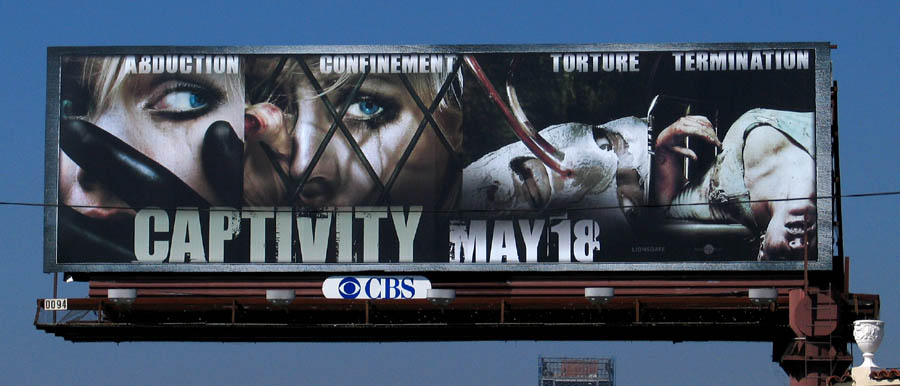
The Los Angeles Times (LAT) had a brief story on Friday about the upcoming horror film, Captivity. According to http://www.imdb.com, a man and a woman wake up captives of a kidnapper, intent upon driving them insane.
The Motion Picture Association of America (MPAA) decided to slap sanctions on the film following an ad campaign launched by the film's makers, After Dark Films. "The sanctions come after ads depicting kidnapping and murder that the MPAA said were inappropriate were placed on billboards in Los Angeles and on cabs in New York." (LAT)
The film is scheduled to be released on May 18. However, the MPAA has said it will not rate the film for thirty days AND it will require approval of every advertisement and every poster location. The LAT says this move was unprecedented.
The film makers could choose to release the movie without a rating, but this may have an impact on the number of theatres willing to show the movie.
To decide for yourself, here's a link to the billboards that the MPAA found so offensive.
The Los Angeles Times (LAT) had a brief story on Friday about the upcoming horror film, Captivity. According to http://www.imdb.com, a man and a woman wake up captives of a kidnapper, intent upon driving them insane.
The Motion Picture Association of America (MPAA) decided to slap sanctions on the film following an ad campaign launched by the film's makers, After Dark Films. "The sanctions come after ads depicting kidnapping and murder that the MPAA said were inappropriate were placed on billboards in Los Angeles and on cabs in New York." (LAT)
The film is scheduled to be released on May 18. However, the MPAA has said it will not rate the film for thirty days AND it will require approval of every advertisement and every poster location. The LAT says this move was unprecedented.
The film makers could choose to release the movie without a rating, but this may have an impact on the number of theatres willing to show the movie.
To decide for yourself, here's a link to the billboards that the MPAA found so offensive.
Friday, March 30, 2007
Predictions for the New World
Nathan Bransford posed an interesting question on his blog Wednesday. Prompted by the changes Borders was implementing, he asked which way the industry was headed.
The comments that followed fell into predictable categories: those waxing eloquent about the experience of visiting a bookstore, those who admit that they find the convenience of on-line shopping a plus, a few who acknowledge immediacy is important and the occasional mention of price. Several people commented that bookstores would always survive because they provide customer service.
Here are my predictions together with my reasons:
1) The niche market specializing in mysteries, sci-fi, children's books, etc. will move entirely to the Internet. Why? Geography and economics. Even when the store is located in a large city, where presumably there are enough customers interested in that niche, the buyer must travel to one location. There he finds that the store, burdened by bricks-and-mortar overhead, cannot match the deep discounts offered elsewhere by retailers doing larger volume business.
It makes more business sense for that bookseller to operate online from his home with much lower overhead and where his customers are only a click away. He can still offer his expertise and service, but now he isn't competing on price or geographic convenience. He's offering a home to the niche buyers. If he's smart, he'll provide an online community for those niche buyers (widely separated by space) to chat about books and authors
ad nauseum.
2) The big box stores like Wal-Mart will continue to skim the cream off the top by offering best-sellers at deep discounts. These stores can make a profit on a very narrow margin because of the enormous volume of their sales.
Wal-Mart is engaged in an aggressive expansion program, putting a store within a mile or two of every American consumer. Rather than expanding booksales to more English mid-list books, I predict Wal-Mart will concentrate on providing best-sellers in foreign languages--whatever language is predominate in the local population that immediately surrounds a specific store (Hispanic, Indian, Asian).
3) The large bookchains are going to have to re-invent themselves. People who sing the praises of browsing are not necessarily people who purchase books. They may buy a cappuccino while reading the latest issue of Vogue, but that doesn't necessarily translate into book sales.
I predict the large chains will begin to focus on book-related events for which a customer must pay--either by joining an exclusive club or by straight ticket sales. I'd probably be willing to pay $35 to $45 for a guaranteed seat to hear Lee Child or Jim Butcher speak, including an autographed copy of their newest releases.
Community will be the key word here. While I talked about virtual communities for niche markets above, here the focus will be on real communities for broader markets. The chains could help set up bookclubs or writing groups and provide space for those groups to meet. Writers would be willing to pay for workshops.
Eventually, the chain bookstores will move into the used market (as e-books grow in popularity).
4) The universe of electronic books will continue to grow, but that growth will be directly related to newer generations of e-reading devices coming on the market. As those devices become more sophisticated and less expensive, this market will explode.
Check back with me in two years, and we'll see how close I came to the mark.
The comments that followed fell into predictable categories: those waxing eloquent about the experience of visiting a bookstore, those who admit that they find the convenience of on-line shopping a plus, a few who acknowledge immediacy is important and the occasional mention of price. Several people commented that bookstores would always survive because they provide customer service.
Here are my predictions together with my reasons:
1) The niche market specializing in mysteries, sci-fi, children's books, etc. will move entirely to the Internet. Why? Geography and economics. Even when the store is located in a large city, where presumably there are enough customers interested in that niche, the buyer must travel to one location. There he finds that the store, burdened by bricks-and-mortar overhead, cannot match the deep discounts offered elsewhere by retailers doing larger volume business.
It makes more business sense for that bookseller to operate online from his home with much lower overhead and where his customers are only a click away. He can still offer his expertise and service, but now he isn't competing on price or geographic convenience. He's offering a home to the niche buyers. If he's smart, he'll provide an online community for those niche buyers (widely separated by space) to chat about books and authors
ad nauseum.
2) The big box stores like Wal-Mart will continue to skim the cream off the top by offering best-sellers at deep discounts. These stores can make a profit on a very narrow margin because of the enormous volume of their sales.
Wal-Mart is engaged in an aggressive expansion program, putting a store within a mile or two of every American consumer. Rather than expanding booksales to more English mid-list books, I predict Wal-Mart will concentrate on providing best-sellers in foreign languages--whatever language is predominate in the local population that immediately surrounds a specific store (Hispanic, Indian, Asian).
3) The large bookchains are going to have to re-invent themselves. People who sing the praises of browsing are not necessarily people who purchase books. They may buy a cappuccino while reading the latest issue of Vogue, but that doesn't necessarily translate into book sales.
I predict the large chains will begin to focus on book-related events for which a customer must pay--either by joining an exclusive club or by straight ticket sales. I'd probably be willing to pay $35 to $45 for a guaranteed seat to hear Lee Child or Jim Butcher speak, including an autographed copy of their newest releases.
Community will be the key word here. While I talked about virtual communities for niche markets above, here the focus will be on real communities for broader markets. The chains could help set up bookclubs or writing groups and provide space for those groups to meet. Writers would be willing to pay for workshops.
Eventually, the chain bookstores will move into the used market (as e-books grow in popularity).
4) The universe of electronic books will continue to grow, but that growth will be directly related to newer generations of e-reading devices coming on the market. As those devices become more sophisticated and less expensive, this market will explode.
Check back with me in two years, and we'll see how close I came to the mark.
Thursday, March 29, 2007
Name Change
Last year, Times Warner sold their Warner Books operation to French publisher, Hachette Livre.
This week, Hachette Livre announced a name change for their new American acquisition. Warner Books will now be known as Grand Central Publishing. That name reflects their new address near the famous New York station.
This week, Hachette Livre announced a name change for their new American acquisition. Warner Books will now be known as Grand Central Publishing. That name reflects their new address near the famous New York station.
Three Shots That Make My Heart Melt
I'm supposed to be reading and judging entries in an erotic romance contest for a RWA chapter. So, of course, I'm looking for something else to do.
Because it's Wednesday night, and my weekly addiction is about to kick in, I'm going to make a confession. I'm revealing it here because, until now, I've kept this secret from the people in my life. And they never read this blog :)
I LOVE to watch the opening credits of CSI New York on Wednesday nights. I rarely watch the show, but I almost always flip the opening credits on.
My reasons: While I like the theme song, Baba O'Reilly, by the Who (some people call it Teenage Wasteland), I LOVE the opening shot of the third billed actor, Carmine Giovinazzo, who plays Danny. His smile just makes me melt.
Don't get me wrong. I think Gary Sinise, the star of CSI New York is just fine, but Carmine's smile does me in . . . every time.
If you'd like to see a glimpse of that smile, it appears between seconds 17 and 18 here.
I can only remember two other "first shots" of actors that have the same effect on me: One is the first time you see Dennis Quaid as Det. Remy McSwain in the 1987 movie The Big Easy.
If you've never seen the movie, it's a very sexy thriller. Ellen Barkin is a D.A. investigating corruption on the New Orleans police force. Someone suggests she talk to Det. McSwain and calls out, "Remy!" Dennis Quaid turns with a smile, and I become a puddle of goo.
I couldn't find a clip of that first shot, but I did track down the trailer for The Big Easy. It has to be the longest trailer in movie history. You can find it here.
Bit of trivia: The Big Easy was the first film ever sold at Robert Redford's Sundance Film Festival.
Although I am a committed hetero, I can appreciate beauty in a woman. Right now, Angelina Jolie is probably the actress whose looks I most admire. However, my all-time favorite opening shot of a female is of Rita Hayworth in the 1946 movie, Gilda.
I know. I know. I wasn't even born then. But I love old movies. In this film, Hayworth's hair almost deserves its own billing. She flings it around like a lethal weapon. In the scene I'm talking about, Glenn Ford enters her bedroom, and the camera shifts focus. She is bending over. When she straightens, she flings her hair over her head and smiles.
You can see that shot on YouTube here.
I'm easily diverted, I know. Especially when I should be doing something else.
Because it's Wednesday night, and my weekly addiction is about to kick in, I'm going to make a confession. I'm revealing it here because, until now, I've kept this secret from the people in my life. And they never read this blog :)
I LOVE to watch the opening credits of CSI New York on Wednesday nights. I rarely watch the show, but I almost always flip the opening credits on.
My reasons: While I like the theme song, Baba O'Reilly, by the Who (some people call it Teenage Wasteland), I LOVE the opening shot of the third billed actor, Carmine Giovinazzo, who plays Danny. His smile just makes me melt.
Don't get me wrong. I think Gary Sinise, the star of CSI New York is just fine, but Carmine's smile does me in . . . every time.
If you'd like to see a glimpse of that smile, it appears between seconds 17 and 18 here.
I can only remember two other "first shots" of actors that have the same effect on me: One is the first time you see Dennis Quaid as Det. Remy McSwain in the 1987 movie The Big Easy.
If you've never seen the movie, it's a very sexy thriller. Ellen Barkin is a D.A. investigating corruption on the New Orleans police force. Someone suggests she talk to Det. McSwain and calls out, "Remy!" Dennis Quaid turns with a smile, and I become a puddle of goo.
I couldn't find a clip of that first shot, but I did track down the trailer for The Big Easy. It has to be the longest trailer in movie history. You can find it here.
Bit of trivia: The Big Easy was the first film ever sold at Robert Redford's Sundance Film Festival.
Although I am a committed hetero, I can appreciate beauty in a woman. Right now, Angelina Jolie is probably the actress whose looks I most admire. However, my all-time favorite opening shot of a female is of Rita Hayworth in the 1946 movie, Gilda.
I know. I know. I wasn't even born then. But I love old movies. In this film, Hayworth's hair almost deserves its own billing. She flings it around like a lethal weapon. In the scene I'm talking about, Glenn Ford enters her bedroom, and the camera shifts focus. She is bending over. When she straightens, she flings her hair over her head and smiles.
You can see that shot on YouTube here.
I'm easily diverted, I know. Especially when I should be doing something else.
Wednesday, March 28, 2007
More Pod Critic
To do him credit, Pod Critic has not removed my comment to his blog. He has, however, shut off comments in favor of accepting emails from readers.
PC has also done a follow-up post here to the one from Monday. He clearly took exception to my comment that POD is a technology, not a business model. His new post says, "To say that print-on-demand technology is not a business model is to be uninformed."
It's been a while since I took macro and micro economics, but I remembered that a business model had at least half dozen components, depending on the conceptualization you use. I took a shortcut by Googling the term "business model" yesterday. I easily found the system I remembered from undergraduate school.
The components of the business model I'd been taught in micro-economics were: proposition, market segment, value chain structure, revenue generation, position in the value network (food chain), and competitive strategy.
Print-on-demand should be considered a competitive strategy, one of those components of a business model rather than the model itself. Competitive strategy is the means by which a business develops a competitive advantage.
My intention is not to argue with PC. I actually agree with him on several points. However, I believe that--at this point in time--self publishing is a useful strategy only for certain groups. Note that I said certain groups, not everyone.
If you're interested in reading more on this subject, try three of my earlier blogs. Start with the one for June 20, 2006 here. There were two follow-up posts on June 25, 2006, and September 15, 2006.
I honestly believe self-publishing will become a viable means of publication for more writers in the future. However, that time is not yet now.
PC has also done a follow-up post here to the one from Monday. He clearly took exception to my comment that POD is a technology, not a business model. His new post says, "To say that print-on-demand technology is not a business model is to be uninformed."
It's been a while since I took macro and micro economics, but I remembered that a business model had at least half dozen components, depending on the conceptualization you use. I took a shortcut by Googling the term "business model" yesterday. I easily found the system I remembered from undergraduate school.
The components of the business model I'd been taught in micro-economics were: proposition, market segment, value chain structure, revenue generation, position in the value network (food chain), and competitive strategy.
Print-on-demand should be considered a competitive strategy, one of those components of a business model rather than the model itself. Competitive strategy is the means by which a business develops a competitive advantage.
My intention is not to argue with PC. I actually agree with him on several points. However, I believe that--at this point in time--self publishing is a useful strategy only for certain groups. Note that I said certain groups, not everyone.
If you're interested in reading more on this subject, try three of my earlier blogs. Start with the one for June 20, 2006 here. There were two follow-up posts on June 25, 2006, and September 15, 2006.
I honestly believe self-publishing will become a viable means of publication for more writers in the future. However, that time is not yet now.
Tuesday, March 27, 2007
Critiquing Pod Critic
Miss Snark had a link to a relatively new blogger here in her Monday post.
Miss Snark filed his post under "sucka," offering a critique in her uniquely brusque and snarky fashion.
I wrote a lengthy response in POD Critic's comment space. I don't know how long that comment will appear, but I'm going to incorporate parts of it in this post.
Pod Critic states: "The truth is this: print-on-demand technology, as I’ve told others, has the capacity to revolutionize the publishing industry; to alter it almost entirely in fact."
Frankly, I agree with him (I'm going to use the generic "him" since I have no idea of the blogger's gender) that POD is the wave of the future. Richard Curtis made that case nearly a year ago in his keynote address to the Backspace Writers Conference in July. You can read his comments here.
Pod Critic and I begin to part company when he says: "Right now, print-on-demand is an advanced printing technology and business model that is mainly in the hands of rank amateurs."
I know I've said it before, but I'll say it again: POD is a technology, not a business model. It is the technology that permits a publishing house to digitally print one book at nearly the same average price per book as it can print one thousand books. I agree it will overtake the industry, in the same way Gutenberg's printing press once did, simply because it makes economic sense. However, it is NOT a business model. The only people calling it a business model are the presses that specialize in self-publishing, who now call themselves "POD publishers" because it sounds better than "vanity presses."
Self-publishing IS a business model. The technology by which one self-publishes is called printing, whether it be POD or traditional press.
Where POD Critic and I really tear the sheets is when he says: "Many authors, and even a few publishers, employing the method are, in essence, inexpert and unprofessional. That is what happens when there is no real (affordable) training program or adequate learning apparatus readily available to the masses. The entire POD system is, in effect, abused; hence the heavy criticism and standoffish positions from those on the other side."
He's off his nut if he thinks the publishing industry doesn't recognize the potential of POD technology. Large publishers like Random House, HarperMorrow and Simon & Schuster are already busy digitizing their backlists.
Last week, Borders Group announced it is revamping its chain of superstores to create digital centers, which will include assistance for self-published writers.
The real problem with POD has nothing to do with "a lack of training program or adequate learning apparatus" for publishers and authors. Both publishing houses and POD presses know exactly what the technology can do and exactly what it means to their future.
The real problem is that POD publishers have given the technology a bad name by printing whatever dreck comes in the door accompanied by a writer with a check who says she wants to self-publish.
In traditional publishing, the READER is the ultimate end user of the publishing house. In self-publishing, the WRITER is the end user of the POD press. And therein lies the problem. A traditional publisher is betting its future by taking a chance on a writer and a manuscript. If the book bombs, the publisher loses a bunch of money. This is not the case with a POD press. Since they are paid up front, they mostly don't care whether the book sells (some of them retain publishing rights or take a percentage of sales, but that's after their costs are covered by a check from the writer).
Instead of refusing a manuscript of poor quality, the POD press accepts the check and turns out a pretty product, no matter how bad the contents, because the writer is their end user. The poor deluded writer then begins to refer to himself as "published," earning the scorn of the rest of the industry.
Until the self-publishing industry develops a filter system to weed out the garbage, even quality self-published authors will bear a stigma.
Hastings Entertainment just posted its fourth quarter results. According to Publishers Weekly, they were the last of the book retailers to announce disappointing year-end figures, following Borders' disastrous results last week.
If book retailers like Borders believe they can save themselves and inflate their revenues by printing and then selling self-published books without vetting for quality, they are sounding their own death knell. It's a very short-term strategy.
Readers are not stupid people. It will only take getting burned a few times by purchasing a poor-quality self-published book before they will associate the seller with getting ripped off. They will become more wary of unknown writers as well. Unfortunately, this is going to make it even harder for new writers to break into the industry.
Let me repeat myself: What IS needed is a filtering system by which inexperienced and impatient authors seeking to self publish are sent back to the drawing board (the way agents and editors currently handle them) instead of encouraging them by taking their money and filling them with false hope when their writing is not up to par.
Like many others, I'm grieving the loss of POD-dy Mouth. I would welcome a new blogger willing to bring quality self-published books to the attention of readers. However, if Pod Critic wants to fill POD-dy Mouth's shoes, IMHO, he will have to demonstrate three qualities: (1) An ability to pick good books; (2) An ethical compass similar to POD-dy Mouth's. Even though she was an author herself, she never used her forum to promote her own agenda (or books); and (3) A less grandiose sense of his place in the publishing universe.
About #3 above: It's fine to be ambitious and to have enthusiasm for your project. It's another thing entirely to make over-blown statements about the amateur quality of the professionals in an entire industry.
The people at POD presses are professionals. They are professionals at selling a dream to hungry, naive and impatient writers. Their services may be overpriced and their advertising somewhat misleading, but the world runs on a "buyer beware" model. If a writer hasn't taken the time to do her research before diving into a POD contract, it's her own fault. God knows there are lots of blogs and websites that warn against plunging into self-publishing. However, there are lots of warnings against buying into silly "lose weight fast" schemes, too, but that hasn't stopped millions from purchasing foolish devices or dietary supplements.
I wish Pod Critic well. Again, in my opinion, he needs to narrow his focus and tone down his rhetoric.
Miss Snark filed his post under "sucka," offering a critique in her uniquely brusque and snarky fashion.
I wrote a lengthy response in POD Critic's comment space. I don't know how long that comment will appear, but I'm going to incorporate parts of it in this post.
Pod Critic states: "The truth is this: print-on-demand technology, as I’ve told others, has the capacity to revolutionize the publishing industry; to alter it almost entirely in fact."
Frankly, I agree with him (I'm going to use the generic "him" since I have no idea of the blogger's gender) that POD is the wave of the future. Richard Curtis made that case nearly a year ago in his keynote address to the Backspace Writers Conference in July. You can read his comments here.
Pod Critic and I begin to part company when he says: "Right now, print-on-demand is an advanced printing technology and business model that is mainly in the hands of rank amateurs."
I know I've said it before, but I'll say it again: POD is a technology, not a business model. It is the technology that permits a publishing house to digitally print one book at nearly the same average price per book as it can print one thousand books. I agree it will overtake the industry, in the same way Gutenberg's printing press once did, simply because it makes economic sense. However, it is NOT a business model. The only people calling it a business model are the presses that specialize in self-publishing, who now call themselves "POD publishers" because it sounds better than "vanity presses."
Self-publishing IS a business model. The technology by which one self-publishes is called printing, whether it be POD or traditional press.
Where POD Critic and I really tear the sheets is when he says: "Many authors, and even a few publishers, employing the method are, in essence, inexpert and unprofessional. That is what happens when there is no real (affordable) training program or adequate learning apparatus readily available to the masses. The entire POD system is, in effect, abused; hence the heavy criticism and standoffish positions from those on the other side."
He's off his nut if he thinks the publishing industry doesn't recognize the potential of POD technology. Large publishers like Random House, HarperMorrow and Simon & Schuster are already busy digitizing their backlists.
Last week, Borders Group announced it is revamping its chain of superstores to create digital centers, which will include assistance for self-published writers.
The real problem with POD has nothing to do with "a lack of training program or adequate learning apparatus" for publishers and authors. Both publishing houses and POD presses know exactly what the technology can do and exactly what it means to their future.
The real problem is that POD publishers have given the technology a bad name by printing whatever dreck comes in the door accompanied by a writer with a check who says she wants to self-publish.
In traditional publishing, the READER is the ultimate end user of the publishing house. In self-publishing, the WRITER is the end user of the POD press. And therein lies the problem. A traditional publisher is betting its future by taking a chance on a writer and a manuscript. If the book bombs, the publisher loses a bunch of money. This is not the case with a POD press. Since they are paid up front, they mostly don't care whether the book sells (some of them retain publishing rights or take a percentage of sales, but that's after their costs are covered by a check from the writer).
Instead of refusing a manuscript of poor quality, the POD press accepts the check and turns out a pretty product, no matter how bad the contents, because the writer is their end user. The poor deluded writer then begins to refer to himself as "published," earning the scorn of the rest of the industry.
Until the self-publishing industry develops a filter system to weed out the garbage, even quality self-published authors will bear a stigma.
Hastings Entertainment just posted its fourth quarter results. According to Publishers Weekly, they were the last of the book retailers to announce disappointing year-end figures, following Borders' disastrous results last week.
If book retailers like Borders believe they can save themselves and inflate their revenues by printing and then selling self-published books without vetting for quality, they are sounding their own death knell. It's a very short-term strategy.
Readers are not stupid people. It will only take getting burned a few times by purchasing a poor-quality self-published book before they will associate the seller with getting ripped off. They will become more wary of unknown writers as well. Unfortunately, this is going to make it even harder for new writers to break into the industry.
Let me repeat myself: What IS needed is a filtering system by which inexperienced and impatient authors seeking to self publish are sent back to the drawing board (the way agents and editors currently handle them) instead of encouraging them by taking their money and filling them with false hope when their writing is not up to par.
Like many others, I'm grieving the loss of POD-dy Mouth. I would welcome a new blogger willing to bring quality self-published books to the attention of readers. However, if Pod Critic wants to fill POD-dy Mouth's shoes, IMHO, he will have to demonstrate three qualities: (1) An ability to pick good books; (2) An ethical compass similar to POD-dy Mouth's. Even though she was an author herself, she never used her forum to promote her own agenda (or books); and (3) A less grandiose sense of his place in the publishing universe.
About #3 above: It's fine to be ambitious and to have enthusiasm for your project. It's another thing entirely to make over-blown statements about the amateur quality of the professionals in an entire industry.
The people at POD presses are professionals. They are professionals at selling a dream to hungry, naive and impatient writers. Their services may be overpriced and their advertising somewhat misleading, but the world runs on a "buyer beware" model. If a writer hasn't taken the time to do her research before diving into a POD contract, it's her own fault. God knows there are lots of blogs and websites that warn against plunging into self-publishing. However, there are lots of warnings against buying into silly "lose weight fast" schemes, too, but that hasn't stopped millions from purchasing foolish devices or dietary supplements.
I wish Pod Critic well. Again, in my opinion, he needs to narrow his focus and tone down his rhetoric.
Monday, March 26, 2007
Odds and Ends
Spring is here in north Texas, and I have the broken fingernails and aching back to prove it.
I spent all day Sunday working in my yard, including several long hours weeding. The yard looks great, and I feel like something the cats left on the doormat.
Speaking of which, my kennel informed me last week that, should I avail myself of their services for Bobbin and Dinah in the future, I will have to pay a premium for Bobbin. Turns out the little monster wouldn't let anyone into his run while I was away. He attacked workers using claws and teeth. After two days of not being fed, he allowed them to shove his food through the door. But he wasn't letting them in to clean his litter box.
Who'd a-thunk it? I'd asked them to put Dinah in a separate run because I suspected Bob would be irritable about being boarded for the first time (I've always asked my neighbors to keep an eye on him when I've been away before, but didn't want to leave him and Dinah alone at home together). I was afraid he'd take his annoyance out on Dinah, who is still only about half his size.
Bob's never hurt another human before though, and he's a pussycat (no pun intended) with me. When I went to pick him and Dinah up, the kennel manager asked me to go into his run and crate him myself. He was so glad to see me, he let out a shriek and leaped into my arms; I almost ended up on my rump on the floor of the run. He started to lick my cheek like a dog. I was torn between being touched and being aggravated. He howled all the way home in his crate. His voice was hoarse by the time I pulled into my driveway.
Since we've been home again, he won't let me out of his sight. He kept lying down on the weeds I was trying to pull this afternoon and, right now, he's draped around my shoulders like a feline boa. A very, very heavy and hot feline boa.
Talk about separation anxiety.
I have jury duty on Monday . . . and it's my own damn fault.
Earlier this month, one of the administrative assistants at the University pulled jury duty, and I bragged that, after having been called every year for four years in a row, I hadn't had a call in nearly five years. As I said it, I could almost hear the faint sound of a bell tolling. Sure enough, ten days later, I got a jury duty summons.
Don't get me wrong. I'm proud of my nation's judicial system and don't mind serving. I just wish they'd let me pick the week. Somehow, some way, they always serve me notice for EXACTLY the worst possible week.
Oh, well. The last time I was in voir dire, I announced I was a fiction writer and looking forward to the murder trial. The attorneys dumped me like last week's trash.
I'll have to see what kind of trial they're offering me today.
I spent all day Sunday working in my yard, including several long hours weeding. The yard looks great, and I feel like something the cats left on the doormat.
Speaking of which, my kennel informed me last week that, should I avail myself of their services for Bobbin and Dinah in the future, I will have to pay a premium for Bobbin. Turns out the little monster wouldn't let anyone into his run while I was away. He attacked workers using claws and teeth. After two days of not being fed, he allowed them to shove his food through the door. But he wasn't letting them in to clean his litter box.
Who'd a-thunk it? I'd asked them to put Dinah in a separate run because I suspected Bob would be irritable about being boarded for the first time (I've always asked my neighbors to keep an eye on him when I've been away before, but didn't want to leave him and Dinah alone at home together). I was afraid he'd take his annoyance out on Dinah, who is still only about half his size.
Bob's never hurt another human before though, and he's a pussycat (no pun intended) with me. When I went to pick him and Dinah up, the kennel manager asked me to go into his run and crate him myself. He was so glad to see me, he let out a shriek and leaped into my arms; I almost ended up on my rump on the floor of the run. He started to lick my cheek like a dog. I was torn between being touched and being aggravated. He howled all the way home in his crate. His voice was hoarse by the time I pulled into my driveway.
Since we've been home again, he won't let me out of his sight. He kept lying down on the weeds I was trying to pull this afternoon and, right now, he's draped around my shoulders like a feline boa. A very, very heavy and hot feline boa.
Talk about separation anxiety.
I have jury duty on Monday . . . and it's my own damn fault.
Earlier this month, one of the administrative assistants at the University pulled jury duty, and I bragged that, after having been called every year for four years in a row, I hadn't had a call in nearly five years. As I said it, I could almost hear the faint sound of a bell tolling. Sure enough, ten days later, I got a jury duty summons.
Don't get me wrong. I'm proud of my nation's judicial system and don't mind serving. I just wish they'd let me pick the week. Somehow, some way, they always serve me notice for EXACTLY the worst possible week.
Oh, well. The last time I was in voir dire, I announced I was a fiction writer and looking forward to the murder trial. The attorneys dumped me like last week's trash.
I'll have to see what kind of trial they're offering me today.
Sunday, March 25, 2007
Grazergate at The Los Angeles Times
There was a huge flap at the Los Angeles Times this past week that culminated in the resignation of the editorial editor. Andres Martinez resigned on Thursday by way of a self-righteous blog on the LATimes.com website.
The LA Times is the fourth largest newspaper in the U.S. by circulation, behind USA Today, The Wall Street Journal and The New York Times. In June, 2000, the Times was acquired by The Tribune Company of Chicago in "the largest acquisition in newspaper industry history" (Tribune website).
There has been some tension between The Times and its new parent. Last fall, a feud broke out between the two sides when Publisher Jeffery M. Johnson and Editor Dean Baquet both protested reductions in the newspaper dictated by the corporate parent. The Tribune responded in October, 2006, by moving David D. Hiller, formerly publisher, president and CEO of the Chicago Tribune Company, to assume the same role at The LA Times. A month later, in November, 2006, James E. O'Shea became editor of The Times, replacing Baquet.
For the past 18 months (since September, 2005), Andres Martinez has been The Times' OpEd chief. Martinez was in charge of "Current," a redesign of the traditional Sunday Opinion section "offering readers an energetic mix of thought-provoking essays, columns and bold graphic journalism." (Tribune website)
Recently The Times proposed having guest editors host the Sunday "Current" section, and Hollywood producer Brian Grazer was selected as the first host.
This week it was reported that Mr. Martinez is romantically involved with "Kelly Mullens, a senior executive at the public relations firm that represents Mr. Grazer’s production company," raising questions of conflict of interest (New York Times).
When the story broke, the new publisher killed the special section, which was due to appear in today's edition.
Martinez was so outraged that he resigned with a lengthy posting in the newspaper's blog in which he said:
David Hiller's decision to kill the Brian Grazer section this Sunday makes my continued tenure as Los Angeles Times editorial page editor untenable. The person in this job needs to have an unimpeachable integrity, and Hiller's decision amounts to a vote of no confidence in my continued leadership.
Martinez goes on to say that Grazer, Mullens and his colleagues had done nothing wrong. He accepts responsibility for "creating this appearance problem" and says that "the newspaper is overreacting."
The Times' reaction can be better understood if it is taken in context with the newspaper's history and an earlier scandal that seriously hurt its credibility.
That previous incident occurred in late 1999 during the opening of the Staples Center, the sports arena in downtown L.A. The Times had prepared a special 168-page magazine edition to celebrate the opening of the new Center. Without informing the editors and writers who worked on the edition, The Times shared profits from that magazine with the management of Staples Center. This was a conflict of interest and a huge breach of the "Chinese wall" that traditionally separates the functions of journalism and advertising in the newspaper industry. The Times' reputation for integrity suffered a black eye as a result.
The new contretemps began this week when The Los Angeles Times' media reporter, Jim Rainey, learned of the Martinez/Mullens relationship and began asking questions with an eye to writing a story. According to the New York Times:
Mr. Martinez said in an interview yesterday that when he learned of the pending article, he wrote a long e-mail message to Douglas Frantz, one of the paper’s managing editors, and that Mr. Frantz, who was on vacation, had written back saying he did not see a problem. Mr. Martinez also said that Mr. Frantz had told him he did not want Mr. Rainey to pursue the article and that everyone could discuss what to do next week.
Mr. Frantz said in an interview yesterday that he was “trying to buy some time and digest the thing.” But he said he later spoke with Mr. Rainey and realized that there was a problem, especially in light of the Staples Center episode.
Reading that section of The New York Times story, the hairs on the back of my neck went up. If there was no problem, why didn't Martinez simply acknowledge the relationship and contribute a comment to Rainey's story instead of trying to stop the story from running, which was clearly the intent of his call to the managing editor?
On top of that, Martinez' blog posting bothered me. IMHO, he was spreading red herrings all over his trail. Try this little tidbit from his resignation:
We're a long ways removed from the fall of 2004 when Michael Kinsley and John Carroll lured me out to the West Coast, with promises of investing more resources on the LAT opinion pages and web site. Some of the retrenchment is understandable given the business fundamentals, but I have been alarmed recently by the company's failure to acknowledge that our opinion journalism, central to the paper's role as a virtual town square for community debate and dialogue, should not be crudely scaled back as part of across-the-board cuts. Decisions being made now to cut the one part of the paper that is predominantly about ideas and community voices go too far in my view, and are shortsighted.
He also takes potshots at the newsroom staff who uncovered the story:
I will not be lectured on ethics by some ostensibly objective news reporters and editors who lobby for editorials to be written on certain subjects, or who have suggested that our editorial page coordinate more closely with the newsroom's agenda . . .
You can read Martinez' entire resignation here. You can also read The New York Times' take on the story here.
See how you feel about this "appearance problem." For me, it's a case of "Caesar's wife must be above suspicion."
The LA Times is the fourth largest newspaper in the U.S. by circulation, behind USA Today, The Wall Street Journal and The New York Times. In June, 2000, the Times was acquired by The Tribune Company of Chicago in "the largest acquisition in newspaper industry history" (Tribune website).
There has been some tension between The Times and its new parent. Last fall, a feud broke out between the two sides when Publisher Jeffery M. Johnson and Editor Dean Baquet both protested reductions in the newspaper dictated by the corporate parent. The Tribune responded in October, 2006, by moving David D. Hiller, formerly publisher, president and CEO of the Chicago Tribune Company, to assume the same role at The LA Times. A month later, in November, 2006, James E. O'Shea became editor of The Times, replacing Baquet.
For the past 18 months (since September, 2005), Andres Martinez has been The Times' OpEd chief. Martinez was in charge of "Current," a redesign of the traditional Sunday Opinion section "offering readers an energetic mix of thought-provoking essays, columns and bold graphic journalism." (Tribune website)
Recently The Times proposed having guest editors host the Sunday "Current" section, and Hollywood producer Brian Grazer was selected as the first host.
This week it was reported that Mr. Martinez is romantically involved with "Kelly Mullens, a senior executive at the public relations firm that represents Mr. Grazer’s production company," raising questions of conflict of interest (New York Times).
When the story broke, the new publisher killed the special section, which was due to appear in today's edition.
Martinez was so outraged that he resigned with a lengthy posting in the newspaper's blog in which he said:
David Hiller's decision to kill the Brian Grazer section this Sunday makes my continued tenure as Los Angeles Times editorial page editor untenable. The person in this job needs to have an unimpeachable integrity, and Hiller's decision amounts to a vote of no confidence in my continued leadership.
Martinez goes on to say that Grazer, Mullens and his colleagues had done nothing wrong. He accepts responsibility for "creating this appearance problem" and says that "the newspaper is overreacting."
The Times' reaction can be better understood if it is taken in context with the newspaper's history and an earlier scandal that seriously hurt its credibility.
That previous incident occurred in late 1999 during the opening of the Staples Center, the sports arena in downtown L.A. The Times had prepared a special 168-page magazine edition to celebrate the opening of the new Center. Without informing the editors and writers who worked on the edition, The Times shared profits from that magazine with the management of Staples Center. This was a conflict of interest and a huge breach of the "Chinese wall" that traditionally separates the functions of journalism and advertising in the newspaper industry. The Times' reputation for integrity suffered a black eye as a result.
The new contretemps began this week when The Los Angeles Times' media reporter, Jim Rainey, learned of the Martinez/Mullens relationship and began asking questions with an eye to writing a story. According to the New York Times:
Mr. Martinez said in an interview yesterday that when he learned of the pending article, he wrote a long e-mail message to Douglas Frantz, one of the paper’s managing editors, and that Mr. Frantz, who was on vacation, had written back saying he did not see a problem. Mr. Martinez also said that Mr. Frantz had told him he did not want Mr. Rainey to pursue the article and that everyone could discuss what to do next week.
Mr. Frantz said in an interview yesterday that he was “trying to buy some time and digest the thing.” But he said he later spoke with Mr. Rainey and realized that there was a problem, especially in light of the Staples Center episode.
Reading that section of The New York Times story, the hairs on the back of my neck went up. If there was no problem, why didn't Martinez simply acknowledge the relationship and contribute a comment to Rainey's story instead of trying to stop the story from running, which was clearly the intent of his call to the managing editor?
On top of that, Martinez' blog posting bothered me. IMHO, he was spreading red herrings all over his trail. Try this little tidbit from his resignation:
We're a long ways removed from the fall of 2004 when Michael Kinsley and John Carroll lured me out to the West Coast, with promises of investing more resources on the LAT opinion pages and web site. Some of the retrenchment is understandable given the business fundamentals, but I have been alarmed recently by the company's failure to acknowledge that our opinion journalism, central to the paper's role as a virtual town square for community debate and dialogue, should not be crudely scaled back as part of across-the-board cuts. Decisions being made now to cut the one part of the paper that is predominantly about ideas and community voices go too far in my view, and are shortsighted.
He also takes potshots at the newsroom staff who uncovered the story:
I will not be lectured on ethics by some ostensibly objective news reporters and editors who lobby for editorials to be written on certain subjects, or who have suggested that our editorial page coordinate more closely with the newsroom's agenda . . .
You can read Martinez' entire resignation here. You can also read The New York Times' take on the story here.
See how you feel about this "appearance problem." For me, it's a case of "Caesar's wife must be above suspicion."
Friday, March 23, 2007
New Strategy at Borders
Lots going on in the publishing world. It will probably take a couple of days to cover everything that happened while I was away.
Most importantly tonight is all the activity over at Borders Books. The Wall Street Journal (WSJ) had a lengthy article yesterday by Jeffrey A. Trachtenberg, one of my favorite reporters. I've mentioned Trachtenberg's stories multiple times in this blog over the last twenty months.
Earlier this month, on March 8, the Borders Group announced they would hold a discussion on March 22 on "the company's fourth quarter and full year 2006 financial results" and would "outline its strategic plan for the future." Pretty big clue that the fourth quarter was not going to be a winning one.
Yesterday, PRNewswire.com had this to say about the Borders' results:
[T]he company recorded a consolidated loss in the fourth quarter of $1.25 per share, which compares to consolidated earnings per share of $1.78 for the same period in 2005. For the full year . . . Borders Group posted a consolidated loss of $2.44 per share compared to consolidated diluted earnings per share of $1.42 for the prior year.
Yeah, there was a reason for that heads up about the forthcoming results.
After the results were announced, Borders led the promised discussion, describing how they planned to turn things around. The WSJ summarized those plans.
The article began by saying, "For six years, Borders Group Inc. has pursued a distinctly unfashionable strategy: betting big on bricks and mortar while paying little attention to the online world. Now with online sales capturing an ever-increasing share of the book business, the No. 2 book retailer is reversing course."
Trachtenberg was referring to the fact that, in 2001, instead of focusing on the Internet as the future of marketing, former Borders CEO Greg Josefowicz opted to turn over the company's online business to Amazon.com.
[B]usiness trends have proved Borders' strategy wrong. While sales at U.S. bookstores have sagged--down 2.9% last year, according to preliminary estimates from the U.S. Census Bureau--online book sales have soared. Online retailers in 2006 accounted for 13% of the overall book market, up from 2% in 1998, according to R.R. Bowker LLC, which tracks the book industry. (WSJ)
Today the man who replaced Josefowicz eight months ago, new CEO George Jones, announced the following initiatives:
1) Revitalizing the 499 domestic superstores: "Borders is working on a prototype of a new superstore design that will include a digital center. The centers will enable customers to purchase a variety of digital products, including music and audiobooks." The company is also expected to start replacing its CD inventory with downloadable music. Finally, the WSJ reported the company will "provide such services as personal publishing," which I assume means self-publishing. The first of these newly redesigned superstores is expected to open in 2008.
A press release issued by Borders yesterday said, "The company is also planning to publish exclusive and proprietary books to distinguish the Borders brand and drive high margin sales. Numerous agreements are already in process to publish titles by celebrities, undiscovered talents, and others who will create buzz about books that will only be available at Borders."
At the same time, the company plans to close 264 of its 564 Waldenbooks, those smaller stores mostly located in malls.
2) Refocusing investment on the international front: The press release also said that with the exception of "the company's successful Paperchase [stationery retail] business, Puerto Rico stores, or the franchise operations in Malaysia and the United Arab Emirates" and the company's operations in Singapore, Borders will be seeking "strategic alternatives" for its international operation. Borders has retained Merrill Lynch & Co. to help them unload the majority of its 73 superstores overseas.
3) Reinventing the company through technology and strategic alliances: Borders will develop its own Borders.com website independent of Amazon.com.
Trachtenberg reports that, "In addition, the nearly 17 million readers who now participate in the Borders Rewards program will be able to earn customer benefits through online purchases, something they can't do currently with Amazon."
“We need to reinvent our business to exploit the rapid changes taking place in how consumers access information and entertainment,” Jones said. “Our ultimate goal is to make Borders a vital community gathering place where people come together to see, touch, interact, and learn – online and in-store.” (Borders' press release)
Most importantly tonight is all the activity over at Borders Books. The Wall Street Journal (WSJ) had a lengthy article yesterday by Jeffrey A. Trachtenberg, one of my favorite reporters. I've mentioned Trachtenberg's stories multiple times in this blog over the last twenty months.
Earlier this month, on March 8, the Borders Group announced they would hold a discussion on March 22 on "the company's fourth quarter and full year 2006 financial results" and would "outline its strategic plan for the future." Pretty big clue that the fourth quarter was not going to be a winning one.
Yesterday, PRNewswire.com had this to say about the Borders' results:
[T]he company recorded a consolidated loss in the fourth quarter of $1.25 per share, which compares to consolidated earnings per share of $1.78 for the same period in 2005. For the full year . . . Borders Group posted a consolidated loss of $2.44 per share compared to consolidated diluted earnings per share of $1.42 for the prior year.
Yeah, there was a reason for that heads up about the forthcoming results.
After the results were announced, Borders led the promised discussion, describing how they planned to turn things around. The WSJ summarized those plans.
The article began by saying, "For six years, Borders Group Inc. has pursued a distinctly unfashionable strategy: betting big on bricks and mortar while paying little attention to the online world. Now with online sales capturing an ever-increasing share of the book business, the No. 2 book retailer is reversing course."
Trachtenberg was referring to the fact that, in 2001, instead of focusing on the Internet as the future of marketing, former Borders CEO Greg Josefowicz opted to turn over the company's online business to Amazon.com.
[B]usiness trends have proved Borders' strategy wrong. While sales at U.S. bookstores have sagged--down 2.9% last year, according to preliminary estimates from the U.S. Census Bureau--online book sales have soared. Online retailers in 2006 accounted for 13% of the overall book market, up from 2% in 1998, according to R.R. Bowker LLC, which tracks the book industry. (WSJ)
Today the man who replaced Josefowicz eight months ago, new CEO George Jones, announced the following initiatives:
1) Revitalizing the 499 domestic superstores: "Borders is working on a prototype of a new superstore design that will include a digital center. The centers will enable customers to purchase a variety of digital products, including music and audiobooks." The company is also expected to start replacing its CD inventory with downloadable music. Finally, the WSJ reported the company will "provide such services as personal publishing," which I assume means self-publishing. The first of these newly redesigned superstores is expected to open in 2008.
A press release issued by Borders yesterday said, "The company is also planning to publish exclusive and proprietary books to distinguish the Borders brand and drive high margin sales. Numerous agreements are already in process to publish titles by celebrities, undiscovered talents, and others who will create buzz about books that will only be available at Borders."
At the same time, the company plans to close 264 of its 564 Waldenbooks, those smaller stores mostly located in malls.
2) Refocusing investment on the international front: The press release also said that with the exception of "the company's successful Paperchase [stationery retail] business, Puerto Rico stores, or the franchise operations in Malaysia and the United Arab Emirates" and the company's operations in Singapore, Borders will be seeking "strategic alternatives" for its international operation. Borders has retained Merrill Lynch & Co. to help them unload the majority of its 73 superstores overseas.
3) Reinventing the company through technology and strategic alliances: Borders will develop its own Borders.com website independent of Amazon.com.
Trachtenberg reports that, "In addition, the nearly 17 million readers who now participate in the Borders Rewards program will be able to earn customer benefits through online purchases, something they can't do currently with Amazon."
“We need to reinvent our business to exploit the rapid changes taking place in how consumers access information and entertainment,” Jones said. “Our ultimate goal is to make Borders a vital community gathering place where people come together to see, touch, interact, and learn – online and in-store.” (Borders' press release)
Thursday, March 22, 2007
Contracting With An Agent
I didn't get home from the airport until almost 11 PM last night, and I'm moving r-e-a-l-l-y s-l-o-w this morning. I just finished unpacking and throwing all my laundry from the trip into the washing machine. Then I need to take the rest to the dry cleaners and pick up Tribble from the vet.
I just read a column of Miss Snark's for 3/21/07 here that I wanted to mention. A snarkling had written asking whether agents charge expenses. It reminded me of my experience with this.
It was December, 2005, and I had just been offered representa-tion by my wonderful, brilliant agent. I was incredibly excited. Then I got the contract and there was a clause indicating that I would be responsible for expenses incurred in selling my manuscript.
I had been reading everything I could on this business and had seen tons of warnings against paying an agent for expenses in marketing manuscripts. I panicked. Not knowing what else to do, I emailed Miss Snark and explained my dilemma.
Within the hour, the lovely MS had emailed me back, explaining that this was a totally legitimate clause in a contract.
Several important points she made to me:
1) The "expense clause" is always AFTER the fact. It doesn't kick in until the manuscript is sold, and the expenses come out of the proceeds of that sale. Crooked agents almost always want a check upfront before they've sold anything.
2) The author is never asked to write a check. The expenses are subtracted from the first check received from the publisher via the agent (You understand, don't you, that checks ALWAYS are sent from the publisher to the agent? The agent takes his/her cut and forwards the remainder to the writer).
3) The amount is nominal. Miss Snark says her expenses are limited to $300. That's in line with my agent's clause.
Miss Snark's kindly response allowed me to relax.
While I'm talking on this subject, let me mention a couple of other things about contracting with an agent.
You should always do research on your agent. Know the genres she represents, know the sales she's made, know her reputation in the writing world. You don't want to sign a legal document with a complete stranger.
Do your homework. EPIC--the Electronically Published Internet Connection--has both a sample contract here and "red flags" to avoid here. I downloaded both and used that advice in vetting my contract. I also took it a step further and asked my attorney to read the contract for me.
If there's something you either don't understand or don't agree with in your contract, for heaven's sake address it before you sign. My agent was very agreeable to talking over the clauses that my attorney had earmarked. In almost every case, my agent agreed that the language changes I wanted clarified the expectations, and we incorporated those changes into a revised contract.
Pay as much attention to how your relationship can end as to how it will commence. My agent was very clear on this, but in the time since, I've seen some scary contracts from other agents.
Understand that the agent must receive compensation for a book he shopped for you IF it sells--even after your relationship ends. That will mean a clause that says something to this effect: If you and your agent rip the sheets, he will receive his agent's fee (15%) for any book that sells as a part of his efforts. For instance, say he offered your book How to Retile a Bathroom to six publishers. If you and he part ways and then, four months later, Publisher A calls to say they want the book, the first agent is still entitled to receive his fee because he initiated the contact. This is not open-ended. Most contracts include a clause as to how long the period during which he will be credited for his efforts will last. Six months is pretty standard although I have seen contracts that say a year.
This is one of the big reasons why you need to have a list of the publishers to whom your agent shopped your manuscript. Make sure there's language in your contract about your agent providing you with a WRITTEN list of places to which your manuscript was submitted. It doesn't have to be formal; it can even be by email. You just need some evidence of which publishers have seen your work. Otherwise, it could get sticky if Agent 1 claims he solicited Publisher A on your behalf AFTER the fact.
A contract with a second agent must be very clear on expectations regarding Agent 1. Many agents' contracts are written to cover any manuscript sold during the period of the contract. If you don't have language in the second agent's contract that clarifies this to mean only any book sold by Agent 2, you could find yourself paying 15% to two agents for one book.
I need to run. If I think of other contract issues, I'll do another posting on this subject.
I just read a column of Miss Snark's for 3/21/07 here that I wanted to mention. A snarkling had written asking whether agents charge expenses. It reminded me of my experience with this.
It was December, 2005, and I had just been offered representa-tion by my wonderful, brilliant agent. I was incredibly excited. Then I got the contract and there was a clause indicating that I would be responsible for expenses incurred in selling my manuscript.
I had been reading everything I could on this business and had seen tons of warnings against paying an agent for expenses in marketing manuscripts. I panicked. Not knowing what else to do, I emailed Miss Snark and explained my dilemma.
Within the hour, the lovely MS had emailed me back, explaining that this was a totally legitimate clause in a contract.
Several important points she made to me:
1) The "expense clause" is always AFTER the fact. It doesn't kick in until the manuscript is sold, and the expenses come out of the proceeds of that sale. Crooked agents almost always want a check upfront before they've sold anything.
2) The author is never asked to write a check. The expenses are subtracted from the first check received from the publisher via the agent (You understand, don't you, that checks ALWAYS are sent from the publisher to the agent? The agent takes his/her cut and forwards the remainder to the writer).
3) The amount is nominal. Miss Snark says her expenses are limited to $300. That's in line with my agent's clause.
Miss Snark's kindly response allowed me to relax.
While I'm talking on this subject, let me mention a couple of other things about contracting with an agent.
You should always do research on your agent. Know the genres she represents, know the sales she's made, know her reputation in the writing world. You don't want to sign a legal document with a complete stranger.
Do your homework. EPIC--the Electronically Published Internet Connection--has both a sample contract here and "red flags" to avoid here. I downloaded both and used that advice in vetting my contract. I also took it a step further and asked my attorney to read the contract for me.
If there's something you either don't understand or don't agree with in your contract, for heaven's sake address it before you sign. My agent was very agreeable to talking over the clauses that my attorney had earmarked. In almost every case, my agent agreed that the language changes I wanted clarified the expectations, and we incorporated those changes into a revised contract.
Pay as much attention to how your relationship can end as to how it will commence. My agent was very clear on this, but in the time since, I've seen some scary contracts from other agents.
Understand that the agent must receive compensation for a book he shopped for you IF it sells--even after your relationship ends. That will mean a clause that says something to this effect: If you and your agent rip the sheets, he will receive his agent's fee (15%) for any book that sells as a part of his efforts. For instance, say he offered your book How to Retile a Bathroom to six publishers. If you and he part ways and then, four months later, Publisher A calls to say they want the book, the first agent is still entitled to receive his fee because he initiated the contact. This is not open-ended. Most contracts include a clause as to how long the period during which he will be credited for his efforts will last. Six months is pretty standard although I have seen contracts that say a year.
This is one of the big reasons why you need to have a list of the publishers to whom your agent shopped your manuscript. Make sure there's language in your contract about your agent providing you with a WRITTEN list of places to which your manuscript was submitted. It doesn't have to be formal; it can even be by email. You just need some evidence of which publishers have seen your work. Otherwise, it could get sticky if Agent 1 claims he solicited Publisher A on your behalf AFTER the fact.
A contract with a second agent must be very clear on expectations regarding Agent 1. Many agents' contracts are written to cover any manuscript sold during the period of the contract. If you don't have language in the second agent's contract that clarifies this to mean only any book sold by Agent 2, you could find yourself paying 15% to two agents for one book.
I need to run. If I think of other contract issues, I'll do another posting on this subject.
Subscribe to:
Comments (Atom)